|
MEAMA
Middle East Academy for Medicine of Ageing
In collaboration with
The International Institute on Ageing-United Nations-Malta
(INIA)
Middle-East & North Africa Association on Aging &
Alzheimer's (MENAAA)
Diploma in Dementia Care Course No.
I
2022/2023
Session 1.1 August 26-27, 2022
Overview of Dementia
Epidemiology & Demographic
Location:
Virtual
Organized by
Abyad Medical Center, Lebanon http://www.amclb.com
Middle East Longevity Institute, Lebanon http://www.amclb.com
Introduction
Abyad Medical Center, The Middle East
Academy for Medicine of Ageing and the Middle East &
North Africa Association on Ageing & Alzheimer's announces
the Diploma in Dementia care for the years 2022/2023.
The curriculum developed for the Diploma
will be shared in two Region of the World, the MENA and
the Caribbean. The two Regions will be independent in
administering the Diploma however they will collaborate
and exchange resources that will make the curriculum and
the Diploma a strong initiative in the field of Dementia.
The diploma is designed for health and
allied care practitioners, including but not limited to
physicians, nurses, social workers, psychologists, physiotherapists,
occupational therapists, and health care officers. It
is meant for those currently in those professions, those
training for those professions, those offering training
for those professions and interested in upskilling for
provision of services. The diploma is composed of four
sessions across which 10 modules are divided. The content
aims to increase scientific, clinical, educational and
managerial competencies in dementia care.
Rationale for the Diploma in Dementia Care
People living with Alzheimer's Disease and Related Dementias
(ADRD), along with their caregivers, turn to trusted practitioners
to understand the condition and the challenges they may
face. Worldwide health and social care services and systems
are poorly equipped to offer quality dementia care. There
are critical gaps in dementia education and training.
The MENA Region faces special challenges.
With the demographic transition, most countries in the
region have been and will continue to experience longer
lifespans of their populations. The region is witnessing
rapid rise of non-communicable disease including dementia.
These factors along with many others likely contribute
to the current prevalence of dementia among those 60 and
older in MENA Region.
There is therefore an urgent need to equip
health and allied care practitioners with knowledge and
skills that will allow them to provide the informed, quality,
evidence-based care that is needed to address this burden.
The Diploma in Dementia Care Improvement will offer one
route for such education and training.
Requirements for Diploma Completion
At the end of the course of four sessions, across which
10 modules are divided, participants will receive a postgraduate
Diploma in Dementia Care and will be graduated as
'members of the MENAAA & MEAMA' A network to
stimulate the development and maintenance of services
for health related problems in elderly people in the Middle-
East & North Africa Area
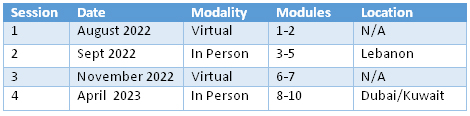
Session Date Modality Modules Location
1 August 2022 Virtual 1-2 N/A
2 Sept 2022 In Person 3-5 Lebanon
3 November 2022 Virtual 6-7 N/A
4 April 2023 In Person 8-10 Dubai/Kuwait
Content Areas
The diploma content includes training
on the science of Alzheimer's Disease and Related Dementias
in older persons. This includes neurology, biology, epidemiology,
and other aspects relevant to improving outpatient care
to facilitate sustainable services and systems of care
that revolve around community services
.
The 10 modules which will be divided into four sessions
are tentatively organized as follows:
1: Overview of Dementia
2: Epidemiology
3: Detection and Diagnosis
4: Medical Treatment of Dementia: Current and Future
5: Non-Pharmacological Management of Dementia
6: Ethics
7: Palliative and End-of-Life Care
8: Dementia Care Pathways
9: Facilitating Team-Based and Person-Centered Care
10: Caring for and Interacting with Caregivers
Program Structure
The Diploma encompasses 10 modules delivered across two
virtual and two in person sessions. Each of the two in
person sessions will take place over two days. The target
number of recipients for the in-person session will be
70-80 health and allied care practitioners. A nominal
registration fee for the in person session will will be
charged to participants.
CEUs/CMEs will be allocated for each module. The same
modules will be repeated every year. In this way, if a
participant is unable to complete any module, s/he can
pick up the session the following year. If all modules
are taken as offered during a specific cohort's offering
(e.g. cohort 1 August 2022-April 2023), the diploma will
take four months to complete and successful completion
of the diploma will be determined by the timely, thorough,
and accurate completion of participation in live sessions
(whether virtual or in person) which will include lectures,
case discussions, and individual presentations.
Accreditation
Application for accreditation of the diploma program will
be made to Alzheimer's Disease International (ADI) after
the first cohort has been completed.
Session One
The first session that covers the two
modules
1-Overview of Dementia &
2-Epidemiology & Demographic Introduction to dementia
will take place virtually between 26-27 August, 2022.
The time will be Between 4 to 8 in the afternoon: Beirut
time
There is no registration fees for the virtual session
and minimal fees for the presential session to defray
the cost.
At the completion of the session participant
will receive certificate of attendance and a total of
10 CME credit hours
The meeting will take place on Zoom
on Friday and Saturday between 4 to 8 pm Beirut time
Register in advance for this meeting:
https://us02web.zoom.us/meeting/register/tZMldu2srjguHNO3eo5LQYMTA4OUIr4tB5Mx
After registering, you will receive a confirmation email
containing information about joining the meeting.
I am attaching the tentative program ,
please register on Zoom to secure your place
We look forward to welcoming you
Sincerely
A. Abyad, MD, MPH, MBA, DBA, AGSF , AFCHSE
CEO, Abyad Medical Center, Lebanon.
Chairman, Middle-East Academy for Medicine of Aging
President, the Middle East & North Africa Association
on Ageing & Alzheimer's
Contact Information
Abyad Medical Center
Secretariat
Hiba Chharani
E-mail amc_lb@yahoo.com
Mobile :
+961-3-245740
+961-6-443684/5/6
Dr. A. Abyad
E-mail aabyad@cyberia.net.lb
Mobile: +961-3-201901
www.meama.com
www.menaaa.org
www.amclb.com
www.facebook.com/meamalb
This educational program was made possible
thanks to sponsorship from Roche. All educational content
is independent from Roche.

Diploma In Dementia Care
Session 1 -Overview of Dementia /Epidemiology & Demographic
26-27 August, 2022
4-8 pm Lebanon Time (Virtual )
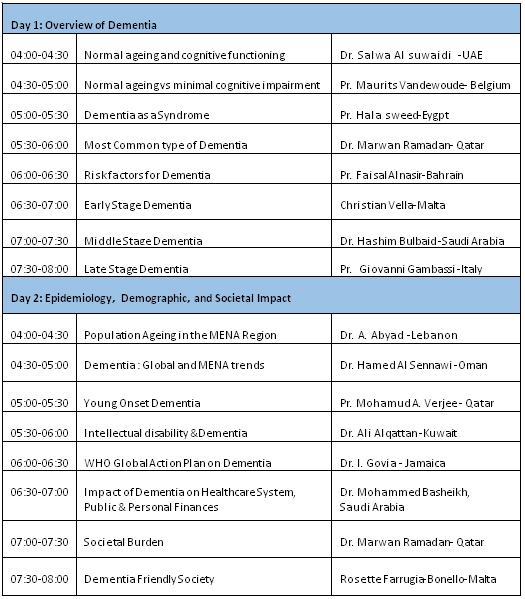
Day 1: Overview of Dementia
04:00-04:30
Normal ageing and cognitive functioning
Dr. Salwa Al suwaidi -UAe
04:30-05:00
Normal ageing vs minimal cognitive impairment
Pr. Maurits Vandewoude- Belgium
05:00-05:30
Dementia as a Syndrome
Pr. Hala sweed-Eygpt
05:30-06:00
Most Common type of Dementia
Dr. Marwan Ramadan- Qatar
06:00-06:30
Risk factors for Dementia
Pr. Faisal Alnasir-Bahrain
06:30-07:00
Early Stage Dementia
Christian Vella-Malta
07:00-07:30
Middle Stage Dementia
Dr. Hashim Bulbaid -Saudi Arabia
07:30-08:00
Late Stage Dementia
Pr. Giovanni Gambassi -Italy
Day 2: Epidemiology, Demographic, and Societal Impact
04:00-04:30
Population Ageing in the MENA Region
Dr. A. Abyad -Lebanon
04:30-05:00
Dementia : Global and MENA trends
Dr. Hamed Al Sennawi -Oman
05:00-05:30
Young Onset Dementia
Pr. Mohamud A. Verjee - Qatar
05:30-06:00
Intellectual disability &Dementia
Dr. Ali Alqattan -Kuwait
06:00-06:30
WHO Global Action Plan on Dementia
Dr. I. Govia - Jamaica
06:30-07:00
Impact of Dementia on Healthcare System, Public &
Personal Finances
Dr. Mohammed Basheikh, Saudi Arabia
07:00-07:30
Societal Burden
Dr. Marwan Ramadan- Qatar
07:30-08:00
Dementia Friendly Society
Rosette Farrugia-Bonello-Malta
|